
- July 30, 2025
- Posted by: admin
- Categories: Gender & Protection, Projects, Stories
WSF gender policy reforms in Somalia are tackling deep-rooted inequalities that affect women and girls across the country. In Somalia, gender disparities remain some of the most severe in the Horn of Africa. From access to education and healthcare to fair representation in decision-making, women and girls continue to be left behind.
According to UN Women, only 24% of Somali girls finish primary school, and fewer than 10% go on to secondary education. Women’s participation in formal jobs is extremely low. Gender-based violence (GBV) is widespread and often goes unreported. A 2023 UNFPA report found that 98% of Somali women aged 15 to 49 have undergone female genital mutilation, the highest rate globally.
Despite decades of humanitarian work, these numbers remain unchanged. Policies exist, but most do not reflect the lived experiences of Somali women especially those in rural communities. These women are rarely part of national policy discussions.
Bridging the Gap Between Policy and People
Somalia has adopted various gender policies and signed international agreements. However, these efforts often stay on paper. Most gender-focused programs are not fully funded, and many lack input from the communities they aim to support.
“This isn’t about the absence of policies,” said Hafsa Bilow, WSF Project Manager. “It’s about the absence of a genuine bridge between policymakers and communities. Women are not just beneficiaries. They are stakeholders, and they must be treated as such.”
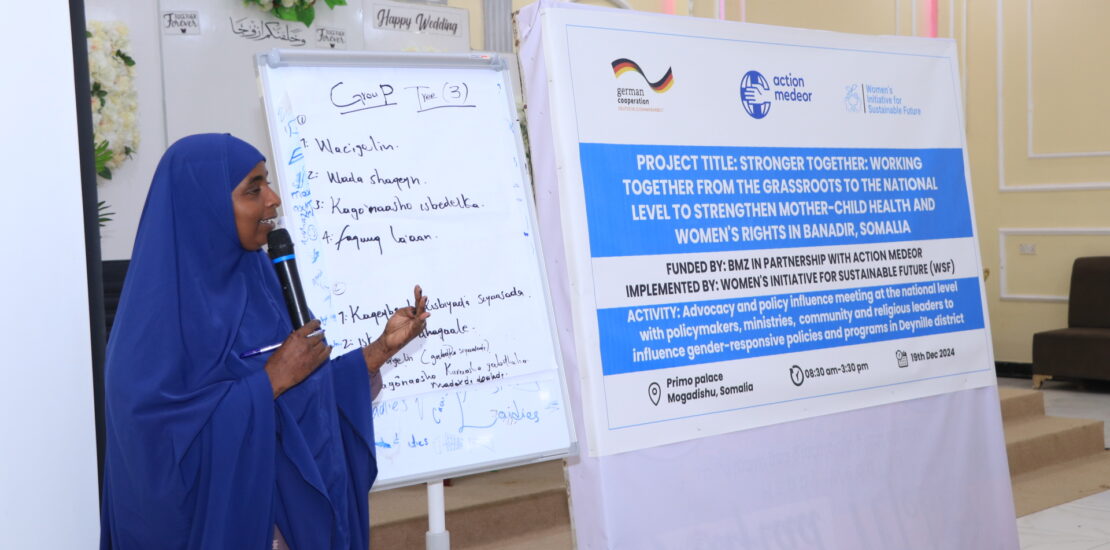
To address this disconnect, WSF convened a high-level policy dialogue in Mogadishu, bringing together national government ministries, civil society organizations, community elders, religious leaders, and women’s rights advocates for a full day of candid discussion and collaborative planning.
This convening was part of the Stronger Together project funded by action medeor and BMZ whose goal is to strengthen protection systems and women’s development across Somalia.
The conference hall in Mogadishu was full, buzzing with energy. For many attendees, especially women from local community, it was the first time they spoke directly with government leaders about policy.
The dialogue covered a review of gender gaps in national policy, strategies to integrate gender equity into health, education, and the economy, cross-sector collaboration between communities, civil society, and government, and commitments to support GBV prevention and girls’ education.
For many participants, especially women from local CSOs and traditional elders, this was the first time they had engaged in direct policy conversations on such a scale.
“It was encouraging to see religious leaders and government officials not just listening, but taking notes, asking questions, and expressing a willingness to act,” said Fatima Ibrahim, , a women’s rights advocate from Banadir region who attended the meeting. “We felt visible. We felt heard. That is a powerful starting point.”
Early Results and Commitments
The event led to a verbal commitment from the Ministry of Women and Human Rights Development to expand funding for community-led GBV programs in three rural districts. WSF will work closely with the ministry to monitor and support the implementation.
Government officials also agreed that women’s protection and development are not side issues. They are central to peace and progress. Several leaders even requested that WSF replicate the dialogue model in other regions.
For years, Somali women have borne the brunt of war, displacement, and poverty. However, through WSF’s gender policy reforms in Somalia, a shift is happening. This new approach emphasizes dialogue, shared accountability, and community ownership.
“We don’t expect change overnight,” said Asha Farah, a women’s rights advocate. “But we expect momentum. And this time, it feels real.”